
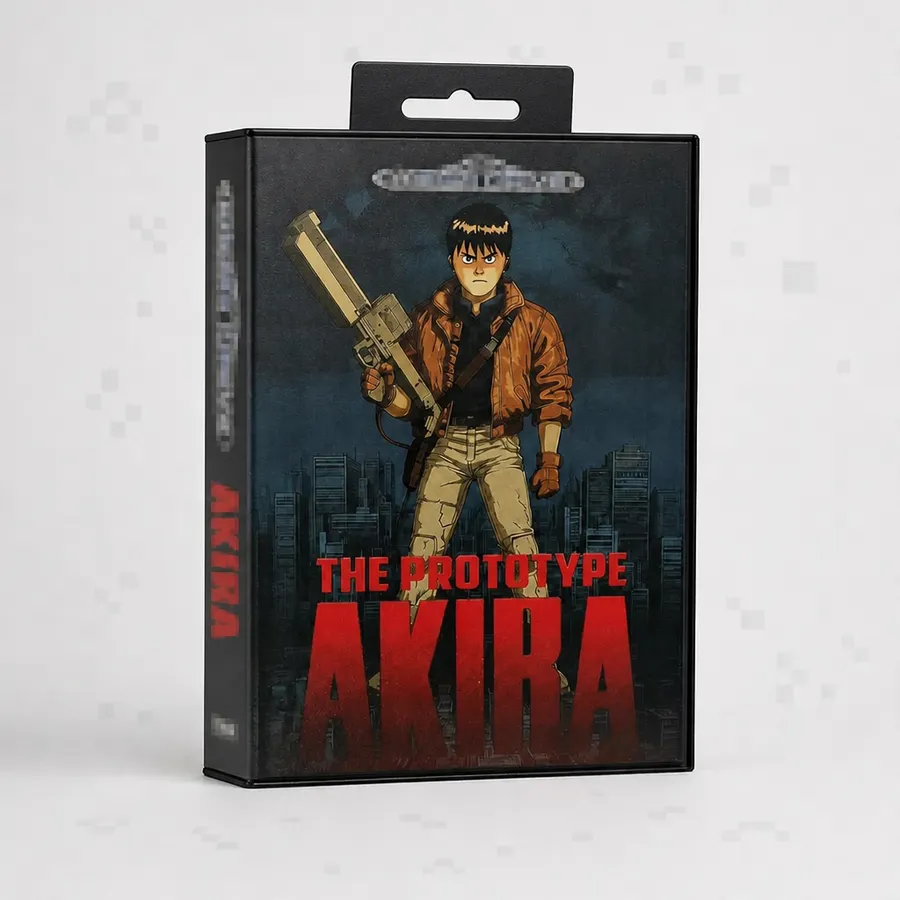
How Akira Became Mega Drive's Lost Prototype
In the early 1990s, a licensed game based on Katsuhiro Otomo's Akira was in the works for the Sega Mega Drive (the Genesis in North America). Black Pearl Software, a studio owned by THQ, began development around 1993 with a release pencilled in for 1995. The plan was ambitious: adapt key scenes from the film as a patchwork of different genres rather than one repeated formula. Preview footage appeared at the Summer Consumer Electronics Show in 1994, and then the game simply vanished.
At a glance
- Based on: the 1988 anime film Akira (an unreleased 1990s licensed game)
- Created by: Black Pearl Software (publisher: THQ)
- Released: never in its time; the prototype surfaced on 25 December 2019
- Genre: mixed: beat 'em up, platformer, first-person shooter and motorcycle chase
- What sets it apart: a cancelled licensed game that survived only as a prototype cartridge
Why it disappeared
Accounts differ. The Hidden Palace preservation project describes it as fading out late in 1994 for lack of interest, while press coverage ties the end to a change of direction at THQ. The same coverage says planned SNES and Game Boy versions were dropped too. There is no single, official explanation.
How it was found
- The prototype was dumped from an EPROM cartridge spread over two circuit boards.
- Hidden Palace published it as part of its Holiday 2019 event, on Christmas Day.
- An hour-long gameplay video appeared alongside it, showing an earlier build than the one demonstrated at the 1994 show.
What the original prototype contains
It is unfinished: five levels, each with a Tetsuo or Kaneda route, though none can be completed. The stages include Doom-style hospital corridors, side-scrolling platforming, an isometric bridge section, a pseudo-3D bike escape and a planned Kaneda versus Tetsuo boss fight. Roughly two-thirds of the ROM is reachable in-game, and the sound test even holds music the game never uses.
A collector's angle
This edition is presented as a reimagined, enhanced take on that surviving prototype for the Mega Drive. For Akira fans and collectors of cancelled-game curiosities, it is a rare physical way to explore a what-if from the 16-bit era.