
OpenLara on Game Boy Advance: 3D Tomb Raider on a 16 MHz Handheld
Real-time 3D on the Game Boy Advance is hard. The console has no 3D hardware and no floating-point unit, which is why nearly every GBA game of its era is built from 2D sprites. OpenLara takes the opposite approach. It is an open-source reimplementation of the classic Tomb Raider engine written by the developer known as XProger (Timur Gagiev), and a GBA build of it was publicised in January 2022 after more than a year of work.
At a glance
- Based on: the 1996 Tomb Raider by Core Design, re-created through the OpenLara engine
- Created by: XProger
- Released: public attention in January 2022 (described by its author as an alpha)
- Genre: 3D action-adventure
- What sets it apart: software-rendered 3D running on real GBA hardware
The technical story
According to XProger, the engine was rewritten so it could run on systems with no FPU and without hardware integer division, with software rasterisation and matrix maths done in ARM assembly. Press reports at the time mentioned a frame rate near 20 fps, with the original music and sound effects intact. That is modest by modern standards, but remarkable for a 3D game of this scale on a handheld.
The port was labelled an alpha: only three levels were playable, starting with the Croft Manor tutorial, and the stated aim was to optimise content so the whole game could fit into a 32 MB cartridge.
Why a physical copy is interesting
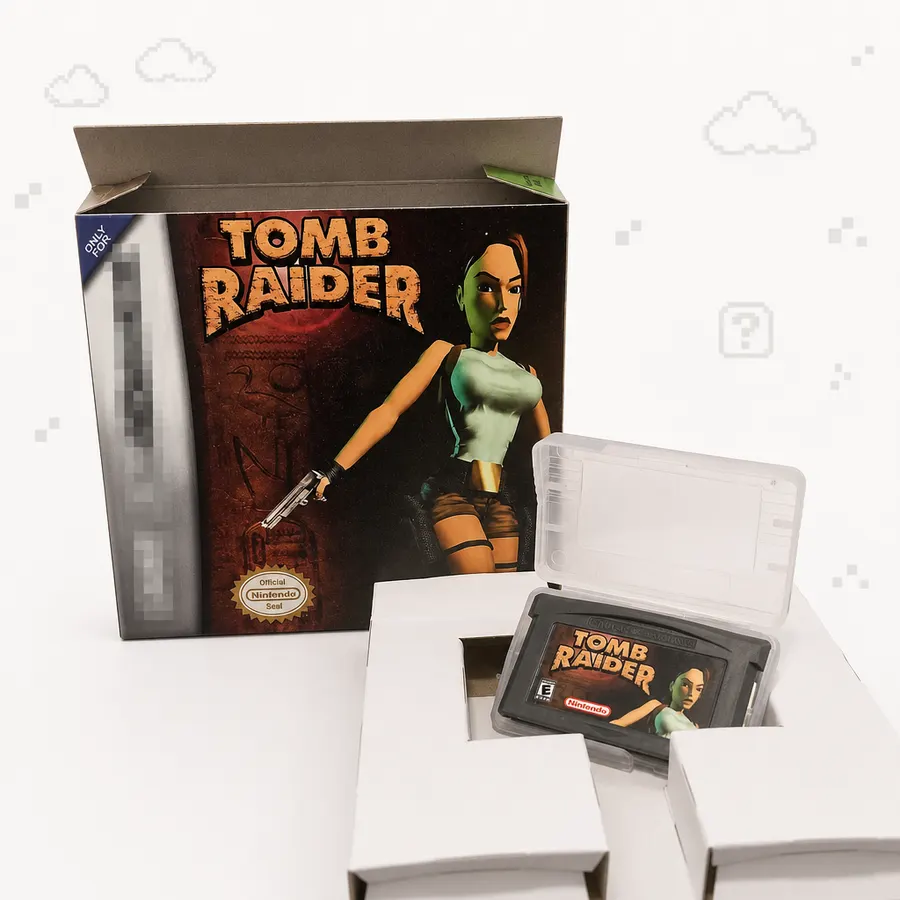
OpenLara itself is published under an open BSD licence. This cartridge is a physical showcase of a modern homebrew experiment rather than a commercial game, so think of it as a demonstration of how far the GBA can be pushed, not a finished retail-style release.